Specialist Psychotherapy Service
.jpg)
WHAT IS CBT?

Cognitive Behavioural Therapy (CBT) is a type of talking therapy with a strong evidence base, proven to be highly effective in helping people overcome a wide range of common mental health difficulties. Not only do CBT therapists like myself demonstrate common factors such as warmth, empathy and trust, we are also highly trained to deliver a broad range of therapeutic techniques in order to guide you on your journey through therapy.
Simply put, CBT is focused upon the idea that our mood/emotions are influenced by our thoughts, behaviours and physical responses, and vice versa. So in any given moment, when we are struggling with a negative thought or an unpleasant feeling, we can often also recognise how that makes us feel physically and how we might react as a result.

Let's take a closer look at how CBT can help you to identify your main difficulties using the following example. Mr X lost his job around seven months ago and understandably has been feeling very low about it. His wife and children have been encouraging him to get up earlier and to start looking for a new job, but he has no energy or motivation to. He spends much of the day laying in bed, skipping meals, not tending to personal hygiene, and generally just feels down, frustrated and fed up. He is lethargic, feels sluggish, his sleep is very poor and has been getting more headaches recently.
What would you suggest to help Mr X?
Well, using the CBT approach illustrated above, we can draw out his symptoms using this framework, as below;
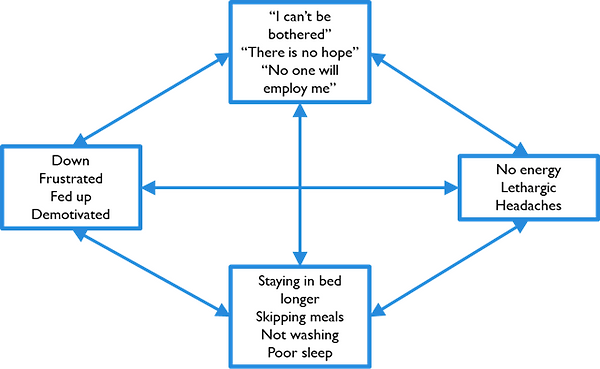
You may already be able to pinpoint some of the difficulties that Mr X is experiencing, and might also have some suggestions for changes he could start making. What CBT will not do is tell him what he needs to do, but rather it asks the necessary questions and helps Mr X to see for himself how these symptoms might be creating a vicious cycle in terms of his low mood. That way, Mr X can start to think about what small changes he can make to his behaviours and also his unhelpful thinking.
CBT absolutely acknowledges the significance of our early life experiences, and helps to inform both the client and therapist of how their beliefs about themselves, others and their view of the world around them are shaped by these experiences, yet CBT really is a here-and-now type of talking therapy, very much interested in helping you make changes to your current issues, and to reduce the distress you are experiencing in the present, as well as minimising the impact it could have on your future.